Diminished Value Claim Guide: Recovering the Value Your Car Lost
Pillar guide
A diminished value claim asks for the drop in your car's market value caused by an accident, on top of the repair bill. Two otherwise identical cars do not sell for the same price when one has a collision on its history report. The repair fixes the car; it doesn't erase the record, and buyers and dealers price that in.
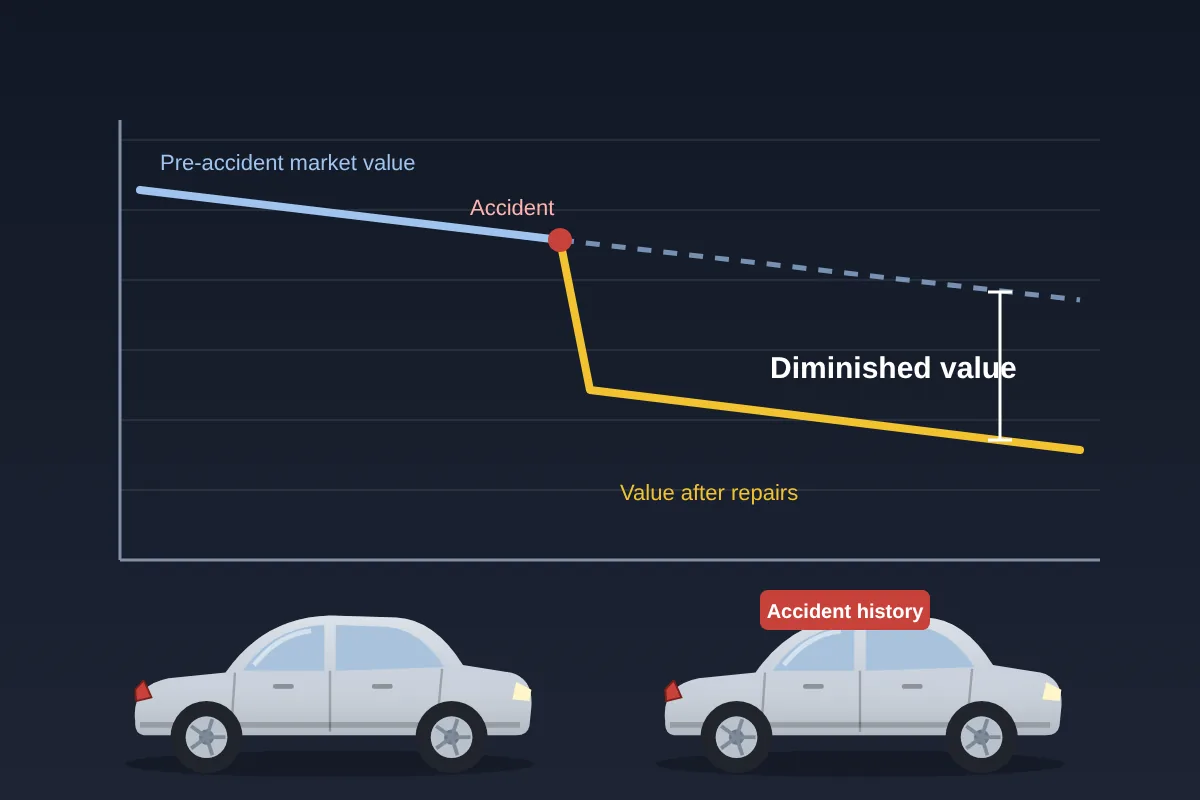
Whether you can recover that loss, and from whom, depends mostly on two facts: who caused the accident and which state you are in. A diminished value claim against an at-fault driver's liability insurer is broadly recognized. A claim against your own insurer is much narrower and turns on your policy language and state law. This guide covers both, plus how the number gets calculated and documented.
Three kinds of diminished value
People use the term loosely, so it helps to separate three ideas:
- Inherent diminished value: the market penalty for having an accident history at all, even after a perfect repair. Most claims are about this. See inherent diminished value.
- Repair-related diminished value: extra value lost because the repair was poor, such as mismatched paint, panel gaps or non-factory parts. This often points to a repair complaint or a supplement rather than a separate value claim.
- Immediate diminished value: the difference between the car's value right before the accident and right after it, unrepaired. It matters mainly in total loss and salvage decisions.
Who pays a diminished value claim
Third-party claims
If another driver caused the crash, you claim against that driver's liability coverage. The legal idea is simple: the person who damaged your property owes you the loss, and lost market value is part of the loss. Nearly every state allows a third-party diminished value claim in some form. Our third-party diminished value page covers how to present one.
First-party claims
If you claim under your own collision or comprehensive coverage, your insurer's duty comes from the policy. Many policies limit payment to the cost of repair or replacement, and many expressly exclude diminution in value. Georgia is the notable exception, where the state's highest court required insurers to assess diminished value on first-party claims. See first-party diminished value and diminished value laws by state.

How a diminished value claim is calculated
There is no single legal formula. Insurers often start with the 17c formula, which caps the loss at 10% of the car's value and then cuts it further for damage level and mileage. Owners and appraisers more often rely on market evidence: what dealers would pay for the car with and without the accident history, and what comparable accident-history cars sell for. Our how to calculate diminished value page compares the methods, and the free diminished value calculator gives a rough range you can sanity-check.
The diminished value appraisal and report
A written diminished value appraisal is the strongest evidence most owners can bring. It describes the car, the damage and the repair, explains the method and shows the market data behind the number. A thin one-page certificate is easy for an adjuster to dismiss. Our diminished value report page lists what a credible report contains.
State rules worth knowing
State law shapes these claims more than any other single factor. Georgia allows first-party claims; the Texas Supreme Court held that the standard Texas auto policy does not cover diminished value on a fully repaired car; North Carolina's liability statute includes a procedure with appraisers and an umpire for third-party diminished value disputes. Details are on the laws by state, Texas diminished value and Georgia diminished value pages.
Steps for a diminished value claim
- Get the repair completed and keep the final invoice, photos and parts list.
- Confirm who is responsible and which policy you are claiming under.
- Check the deadline: claim and lawsuit time limits differ by state and by claim type. See diminished value deadlines.
- Get a written diminished value appraisal based on market evidence.
- Send a demand with the appraisal attached. Our demand letter guide shows the structure.
- If the insurer refuses or lowballs, see what to do when a diminished value claim is denied.
Every guide in this section
A repaired car is usually worth less than one that was never in an accident. A diminished value claim asks someone to pay that difference.
Blog posts on diminished value
- How an Accident History Report Affects Your Car's Resale Value
- Diminished Value Claim Denied: What to Do Next
- Diminished Value Claim Deadline: How Long You Have and How to Find It
- Writing a Diminished Value Demand Letter That Gets a Real Answer
- Diminished Value on a Leased Car: Who Owns the Claim and Who Pays
- Diminished Value After a Minor Accident: Is It Worth Claiming?
- Frame Damage Diminished Value: Why Structural Repairs Cost the Most
- New Car Diminished Value: Why a Nearly New Car Loses the Most
Diminished Value: common questions
Is a diminished value claim worth it for a minor accident?
Sometimes not. Cosmetic damage on an older, high-mileage car may produce little measurable loss. Newer cars, structural repairs and high-demand models tend to show larger losses. Our minor accident guide explains how to judge it.
Can I file a diminished value claim if the car was a total loss?
Generally no. A total loss is paid at actual cash value, which already reflects the car's full pre-accident value. Diminished value applies to cars that are repaired.
Does my own insurance pay diminished value?
Usually only if your policy or state law says so. Georgia requires it on first-party claims; many other policies exclude it. If someone else caused the crash, claim against their liability coverage instead.
Do I need an appraisal to make a diminished value claim?
It isn't legally required, but a written appraisal with market evidence is far more persuasive than a request with no support.