Diminished Value Calculator: A Rough Range for Your Repaired Car
Part of the diminished value guide
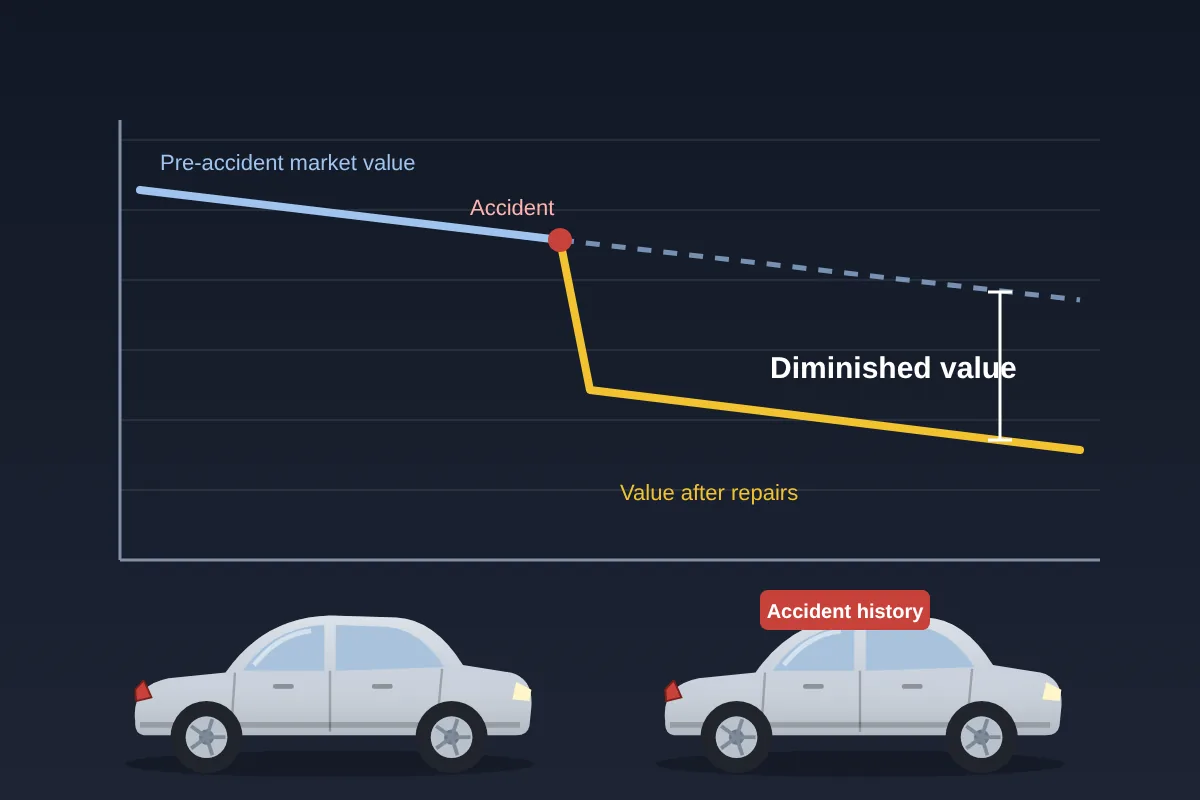
This diminished value calculator gives a rough range for how much market value a repaired car may have lost because of its accident history. It's built for a first look: to tell whether a claim is likely worth pursuing, not to replace a written appraisal.
Diminished value estimator
A rough, educational estimate only. It is not an appraisal, not a 17c result and not what any insurer will pay.
How this works: the range applies a percentage band for the damage level to the pre-accident value, then scales it for vehicle age, mileage, earlier accident history and how large the repair was relative to the car's value. Real diminished value depends on local market evidence, the repair quality and the vehicle itself. A written diminished value appraisal uses comparable sales and dealer input instead of a formula.
Use the diminished value calculator above with numbers from your own records: a realistic pre-accident value from comparable listings, the final repair total and the worst kind of damage involved. The result is labelled an estimate on purpose. Insurers won't pay based on it, and actual loss depends on the market for your specific car.
How the diminished value calculator works
The estimator applies a percentage band to the pre-accident value based on the worst damage involved. Cosmetic repairs get the lowest band and structural or frame repairs the highest. It then adjusts the band for:
- Age: newer cars usually lose more, because buyers of nearly new cars pay a premium for a clean history.
- Mileage: high-mileage cars usually lose less in absolute terms.
- Earlier accident history: a car that already had a reported accident has less clean-history premium left to lose.
- Repair size: repairs that are large relative to the car's value push the band up.
It also shows what the 17c formula would produce for the same inputs. The 17c figure is often much lower; our 17c formula page explains why.
How to pick good inputs
- Pre-accident value: use listings for the same year, trim and similar miles near you, or a pricing guide's retail figure. Don't use what you paid.
- Repair cost: the final invoice total, including supplements.
- Damage level: be honest. Bolt-on bumper covers are cosmetic; welded quarter panels, frame rails, pillars and deployed airbags are not.

Reading the result
Treat the range as a screening tool. If the top of the range is small compared with the cost of an appraisal, a claim may not be worth it. If the range is meaningful, the next step is a written diminished value appraisal built on market evidence, and the methods in how to calculate diminished value.
What the calculator can't know
Local demand for your model, the quality of your repair, whether your car's history report shows the accident, color and options, and the specific facts that move a real buyer. It also can't tell you whether anyone is legally obligated to pay; see laws by state.
Common questions
Is this diminished value calculator accurate?
It produces a rough range based on common patterns, not your car's actual market. It's useful for deciding whether to look further, not for a demand figure.
Why is the 17c number so different?
The 17c formula caps the loss at 10% of value and then applies damage and mileage multipliers that can reduce it to zero. Market-based methods don't use those caps.
Can I send this result to the insurer?
You can, but expect little weight. A written appraisal with market evidence is far more persuasive.